

 Subscribe to The Luncheon Society feed
- 2022 Luncheon Society Season (Note the website is being updated)
- 2021, Luncheon Society Year in Review
- The Luncheon Society at 25
- The 2020 Season of The Luncheon Society: a review
- The Luncheon Society/NY State Poet Laureate and two time National Book Award finalist Alicia Ostriker on “Poetry and the City/Zoom/November 20, 2020
- The Luncheon Society/JPL Mars Rover Mission Control leader John Callas and the future exploration of Mars/Zoom/November 12, 2020
- The Luncheon Society/Ben Bradlee Jr and Richard Wolffe on their thoughts—24 hours before the 2020 Presidential Election/Zoom/November 2, 2020
- Luncheon Society Flashback TBD
- Luncheon Society Flashback TBD
- The Luncheon Society/Former CIA Spymaster Jack Devine on foreign intervention in American elections/Zoom/October 26, 2020
The Luncheon Society—New York/ SNL Pioneer and Thurber Award Winning Humorist Alan Zweibel/June 21, 2013/Bar Americain
Posted in Uncategorized
The Luncheon Society—New York/MSNBC’s Lawrence O’Donnell/June 5, 2013/ Bar Americain
Posted in Uncategorized
The Luncheon Society-San Francisco /Dr. Temple Grandin “The Autistic Brain”/June 4, 2013/Fior D’Italia

This is the fourth time that Dr. Temple Grandin has joined The Luncheon Society. She joined us three times in San Francisco and one time down in Los Angeles. The LA gathering took place in a steak house and she noted, “I better have the steak—after all, it’s the industry I support.”
The first time that Dr. Grandin joined us, it was still several years before Claire Danes portrayed her in the self-titled HBO movie. She was known within autism circles as well as the beef industry—where she redesigned cattle chutes for a more humane approach for processing. She had given an interview on NPR’s Fresh Air with Terry Gross that was so enthralling that I pulled the car to the side of the freeway to listen to it. I think I arrived late an appointment and blamed it on an imaginary accident.
How does somebody on the spectrum think? She explained the difference this way. She would say, “Close your eyes and imagine a church steeple in your mind.” As we closed our eyes, we all pictured a singular steeple merged from all of the churches we’ve ever seen.
However, for an autistic person, hundreds of mental pictures might occur. Dr. Grandin would say, “it’s like Google Images—that is how somebody with autism thinks. Not wrong, but different.” Continue reading
Posted in Uncategorized
TLS-Los Angeles/ Constitutional scholar Adam Winkler/author of Gunfight on gun control and gun ownership/May 9, 2013/Napa Valley Grille
Note—we are now catching up as we rebuild the website.
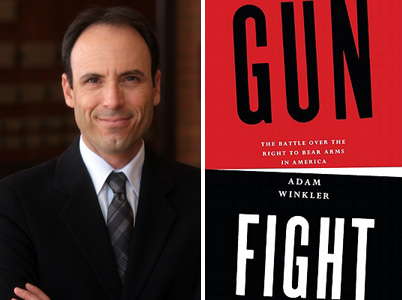 No argument lights up talk-radio like either side of the Second Amendment. As mass shootings take place with a gruesome alacrity, we refight the same fight—as if we are arguing in place—over what is constitutional and what is not.
The book itself follows the Heller case (District of Columbia vs. Heller), which wandered up the appellate route and became a high-profile case that was argued in 2008. What does the Second Amendment mean—does it mean when the founders said, “A well-regulated militia, being necessary to the security of a free state, the right of the people to keep and bear arms, shall not be infringed.
Consider the case of Dick Heller, who was a security guard who lived in a rougher part of the District of Columbia. He could carry a gun at work but was unable to get a permit at home. He wanted to carry a gun at home for his own protection.
As court cases go, the holding contoured along the conservative tilt of the Bush II year, with both Roberts and Alito giving the additional push to get to the 5-4 decision. The case was hatched out of the conservative/libertarian Cato Institute and it gained traction. When the final holding emerged from the Supreme Court, they ruled, “The Second Amendment guarantees an individual’s right to possess a firearm unconnected with service in a militia, and to use that arm for traditionally lawful purposes, such as self-defense within the home. United States Court of Appeals for the District of Columbia Circuit affirmed.”
Posted in Uncategorized
The Luncheon Society—San Francisco Jim Wallis, author of “On God’s Side,” Sojourners editor, liberal Christian writer and social activist/May 3, 2013/Palio d’Asti
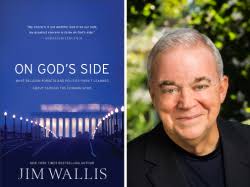 “My concern is not whether God is on our side; my greatest concern is to be on God’s side.”–Abraham Lincoln
Lincoln led America through one of the most tumultuous times in our nation’s history. Reading his words today, it is clear we still have much to learn concerning what it means to be on God’s side.
Bestselling author, public theologian, and leading liberal Christian activist Jim Wallis speaks directly into our current context, revealing the spiritual compass we need to effect lasting change in our society. He explains how the good news of Jesus transforms not only our individual lives but also our public lives. Jesus’s gospel of the kingdom of God helps us recover a personal and social commitment to the common good and shows us–in concrete ways–how to be both personally responsible and socially just. Working together, we can reshape our churches, society, politics, and economy.
In the midst of contentious national debates on gun control, immigration, budget deficits, and more, this book moves the conversations beyond current media and political warfare to bring together a divided country. Wallis explores how Jesus’s agenda can serve the common good, what it takes to sustain a lifelong commitment to social justice, and how reading the Bible as well as the culture can shape our lives for genuine transformation.
Posted in Uncategorized
The Luncheon Society—San Francisco/ Philippe Petit and the World Trade Center walk and his book, “Why Knot”/April 22, 2013/Palio d’Asti
 While so many of our Luncheon Society gatherings address serious subjects, this one was a blast. Philippe Petit had a new book out called “Why Knot,” a playful book on the creation of knots. Petit might come out with the “Yellow Pages,” but everybody still wants to talk about what happened during the summer of 1974, when Petit and his team of Frenchmen climbed the tower and then he began his famous tightrope walk
However, when you think about it knots played an important role in keeping him alive. The tightrope was shot from one tower to the other by bow-and-arrow and then carefully tied down to ensure that he would not fall 110 stories to his death. His action added a special poignancy now that both towers were destroyed in the 9.11 attacks.
His book “Man on Wire” is a riot to read. The book, which became an Academy Award winning documentary, detailed Petit’s extraordinary journey from a dental office in Paris to the chasm between both Towers. It was capped off with a surprise by Petit himself at the Oscar telecast.
There is a new movie arriving in the fall of 2015, directed by Robert Zemeckis, which Joseph Gordon-Levitt as the title role. It will be one of those “tent-pole movies that will hit the theaters this October.
One funny story. On the day Petit walked, it was a foggy day and it was very hard to see him from the ground. His girlfriend stood on the streets below “ginning” up interest by pointing into the sky to a very faint and blurry figure 110 stories up. Continue reading
Posted in Uncategorized
The Luncheon Society—San Francisco/Reagan OMB Director David Stockman on his book The Great Deformation/April 11, 2013/Palio df’Asti
 Okay, we are now catching up on our Luncheon Society gatherings. I have nearly two years of Luncheon Society narratives that will be inserted, roughly 1-2 per day if things go according to plans.
David Stockman, a former congressman who served as Ronald Reagan’s polarizing OMD Director during his term, sat down with The Luncheon Society for a different kind of conversation about the direction of the American economy.
Special thanks for Tim Farley to moderate while I was overseas in Europe. To get a backgrounder on Stockman, please link on the following
- William Greider article in The Atlantic from 1981 http://theatln.tc/1Nxk5bq
- Stockman’s Wikipedia page https://en.wikipedia.org/wiki/David_Stockman
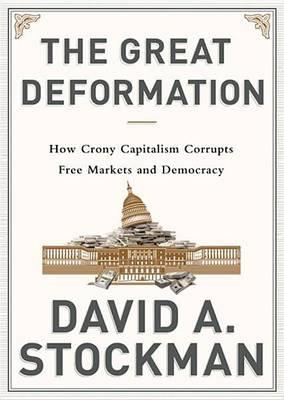 Here is the book jacket blub on The Great Deformation from David Stockman. The Great Deformation is a searing look at Washington’s craven response to the recent myriad of financial crises and fiscal cliffs. It counters conventional wisdom with an eighty-year revisionist history of how the American state—especially the Federal Reserve—has fallen prey to the politics of crony capitalism and the ideologies of fiscal stimulus, monetary central planning, and financial bailouts. These forces have left the public sector teetering on the edge of political dysfunction and fiscal collapse and have caused America’s private enterprise foundation to morph into a speculative casino that swindles the masses and enriches the few.
Posted in Uncategorized
The Luncheon Society—Manhattan/Millennial Futurist David Burstein/February 27, 2013/ Blue Water Grill
Okay, we are now catching up on our Luncheon Society gatherings. I have nearly two years of Luncheon Society narratives that will be inserted, roughly 1-2 per day if things go according to plans.
This Luncheon Society gathering took place in 2013 with a very smart young man who –no doubt-will go very far.
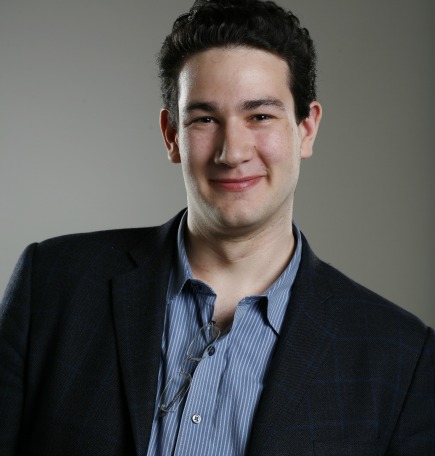 A Millennial examines how his generation is profoundly impacting politics, business, media, and activism. They’ve been called, entitled, narcissistic, “the worst employees in history”, “trophy kids”, and even “the dumbest generation.” But, argues David D. Burstein, the Millennial Generation’s unique blend of civic idealism and savvy pragmatism, combined with their seamless ability to navigate the 21st century world – where constant and fast change is the new normal – will enable them to overcome the short-term challenges of a deeply divided nation and begin to address our world’s long-term challenges.
With eighty million Millennials (people who are today eighteen to thirty years old) coming of age and emerging as leaders in America alone, this is the largest generation in U.S. history, by 2020, its members will represent one out of every three adults in the country. They are more ethnically and racially diverse than their elders, they are the first generation to come of age in a truly global world, and the first to come of age in the new digital era. Millennials have begun their careers amidst a recession which has seen record youth unemployment levels, yet they remain optimistic about their future. Drawing on extensive interviews with his Millennial peers and compelling new research, Burstein illustrates how his generation is simultaneously shaping and being shaped by a fast-paced and fast-changing world. Part oral history, part social documentary, FAST FUTURE reveals the impact and story of the Millennial Generation – in their own words.
Posted in Uncategorized
Updating our TLS naratives
 We should have the rest of the 2013 and 2014 luncheons up on the website soon. To get an idea of our gatherings, please go to our “past gatherings tabs” and learn more.
The Eds.
Posted in Uncategorized
The Luncheon Society—Manhattan/Larry Berman on life of Navy CNO Elmo Zumwalt and the US Navy/March 21, 2013/Bar Americain
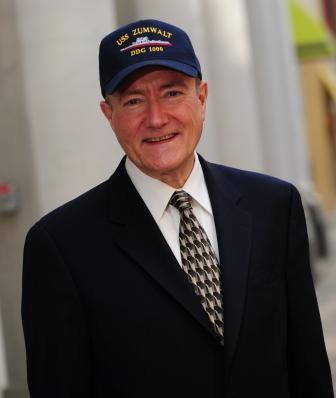 Larry Berman returned to The Luncheon Society with another new book on the Vietnam era. He joined us in Manhattan on his new biography on Elmo Zumwalt, the youngest Chief of Naval Operation is history and who is chiefly responsible for modernizing the US Navy. From 1970 until 1974, his management style lessened the racial tensions, raised morale as the Vietnam War wore down, and dragged the service into the 20th century.
 Larry Berman is also an old professor of mine when I was an undergraduate at UC-Davis. There he wrote three well-regarded policy books of Vietnam, including Planning a Tragedy-The Americanization of the war in Vietnam,” which made the case that Lyndon Johnson knew that he was going to escalate in South Vietnam but craved a consensus position that would create unity from within his government. He found out the hard way that what works for domestic political consensus failed him in foreign affairs. Lyndon-Johnson’s War/The Road to Stalemate in Vietnam, takes us to 1968, when the failure of the decision-making process in July 1965 (from Berman’s first book) is fully observed as a train wreck in policy and politics. The third book, No Peace, No Honor/Nixon, Kissinger, and the Betrayal of South Vietnam, Berman looks at the last years of the American involvement in South Vietnam, as the war winding down. Both Richard Nixon and Henry Kissinger never expected the North Vietnamese to honor the terms of the agreement and once the terms were broken, they would be able to resume bombing runs over various North Vietnamese targets.
For me, as an undergraduate and a student of Larry Berman, I found myself reviewing what few saw at that time, recently declassified documents of the Johnson White House, notes which led up to the decision to escalate American troops. I felt like a fly on the wall and the arguments between McNamara, Rusk, George Ball, and others came alive throughout the rooms in the White House. It was like watching a play and seeing the plot unfold when you already know the ending will be tragic for all involved.
Berman’s next book, his book Perfect Spy: The Incredible Double Life of Pham Xuan An, Time Magazine Reporter and Vietnamese Communist Agent, was well-received both here and in Vietnam. The book told the story of Phạm Xuân Ẩn, served as a North Vietnamese spy while he served as the only accredited Vietnamese reporter for Time Magazine in Saigon. An was also friendly with Nguyễn Cao Kỳ, who served a South Vietnam’s Military chief, Prime Minister and later its Vice President under Nguyễn Van Thieu—An trained Ky’s German Shepards. He was brought into the Communist Party by Le Duc Tho, (who would later negotiate the Paris Peace A cords with Henry Kissinger) who sent him to California to learn about America because Hanoi was convinced that after the French left, the Americans would be next. Interestingly enough, An had the chance to leave as Saigon fell but hung around and even helped the Chief of South Vietnam’s Internal Security Forces escape communist capture.
Posted in Uncategorized
 The Luncheon Society