
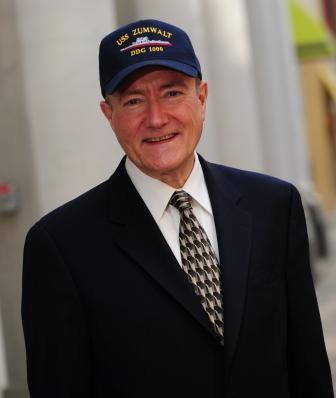
 Larry Berman returned to The Luncheon Society with another new book on the Vietnam era. He joined us in Manhattan on his new biography on Elmo Zumwalt, the youngest Chief of Naval Operation is history and who is chiefly responsible for modernizing the US Navy. From 1970 until 1974, his management style lessened the racial tensions, raised morale as the Vietnam War wore down, and dragged the service into the 20th century.
 Larry Berman is also an old professor of mine when I was an undergraduate at UC-Davis. There he wrote three well-regarded policy books of Vietnam, including Planning a Tragedy-The Americanization of the war in Vietnam,” which made the case that Lyndon Johnson knew that he was going to escalate in South Vietnam but craved a consensus position that would create unity from within his government. He found out the hard way that what works for domestic political consensus failed him in foreign affairs. Lyndon-Johnson’s War/The Road to Stalemate in Vietnam, takes us to 1968, when the failure of the decision-making process in July 1965 (from Berman’s first book) is fully observed as a train wreck in policy and politics. The third book, No Peace, No Honor/Nixon, Kissinger, and the Betrayal of South Vietnam, Berman looks at the last years of the American involvement in South Vietnam, as the war winding down. Both Richard Nixon and Henry Kissinger never expected the North Vietnamese to honor the terms of the agreement and once the terms were broken, they would be able to resume bombing runs over various North Vietnamese targets.
For me, as an undergraduate and a student of Larry Berman, I found myself reviewing what few saw at that time, recently declassified documents of the Johnson White House, notes which led up to the decision to escalate American troops. I felt like a fly on the wall and the arguments between McNamara, Rusk, George Ball, and others came alive throughout the rooms in the White House. It was like watching a play and seeing the plot unfold when you already know the ending will be tragic for all involved.
Berman’s next book, his book Perfect Spy: The Incredible Double Life of Pham Xuan An, Time Magazine Reporter and Vietnamese Communist Agent, was well-received both here and in Vietnam. The book told the story of Phạm Xuân Ẩn, served as a North Vietnamese spy while he served as the only accredited Vietnamese reporter for Time Magazine in Saigon. An was also friendly with Nguyễn Cao Kỳ, who served a South Vietnam’s Military chief, Prime Minister and later its Vice President under Nguyễn Van Thieu—An trained Ky’s German Shepards. He was brought into the Communist Party by Le Duc Tho, (who would later negotiate the Paris Peace A cords with Henry Kissinger) who sent him to California to learn about America because Hanoi was convinced that after the French left, the Americans would be next. Interestingly enough, An had the chance to leave as Saigon fell but hung around and even helped the Chief of South Vietnam’s Internal Security Forces escape communist capture.


 The Luncheon Society